A 4-hour hike in moderate weather calls for roughly 2 liters of water. The same hike in genuine summer heat can push past 4 liters, more than double, before you've changed anything about the trail itself. Temperature does more to your water needs than distance does, which is exactly why this calculator asks about heat and trail intensity separately instead of just duration alone.
The Half-Liter Baseline, and Why It Moves
The American Hiking Society and REI both point to roughly half a liter of water per hour of hiking as a reasonable starting baseline, in moderate temperatures and at a moderate pace. That figure isn't arbitrary, it's built around typical sweat and respiratory water loss during sustained moderate exertion for an average adult. But "moderate" is doing a lot of work in that sentence, the same body on the same trail loses water at a meaningfully different rate once heat, humidity, elevation gain, or pack weight change the equation, which is why treating half a liter per hour as a universal constant undersells what a hot afternoon actually costs you.
Why Heat Changes the Number So Much
Sweat is your body's primary cooling mechanism, and it scales hard with ambient temperature, not linearly but closer to compounding, since heat also makes the same physical effort feel harder, which itself raises your heart rate and sweat output further. REI specifically calls out that strenuous hiking in high heat can require a full liter or more per hour, roughly double the moderate-weather baseline, and hotter, drier days push that figure even further. This calculator reflects that curve with four temperature bands: cool conditions actually reduce the baseline slightly, since you're losing less water to sweat and can comfortably drink less, while the hot and very-hot bands scale the rate up by 60% and 120% respectively, matching the real-world range hiking organizations actually recommend rather than a flat, one-size number.
Trail Intensity: Elevation and Pack Weight
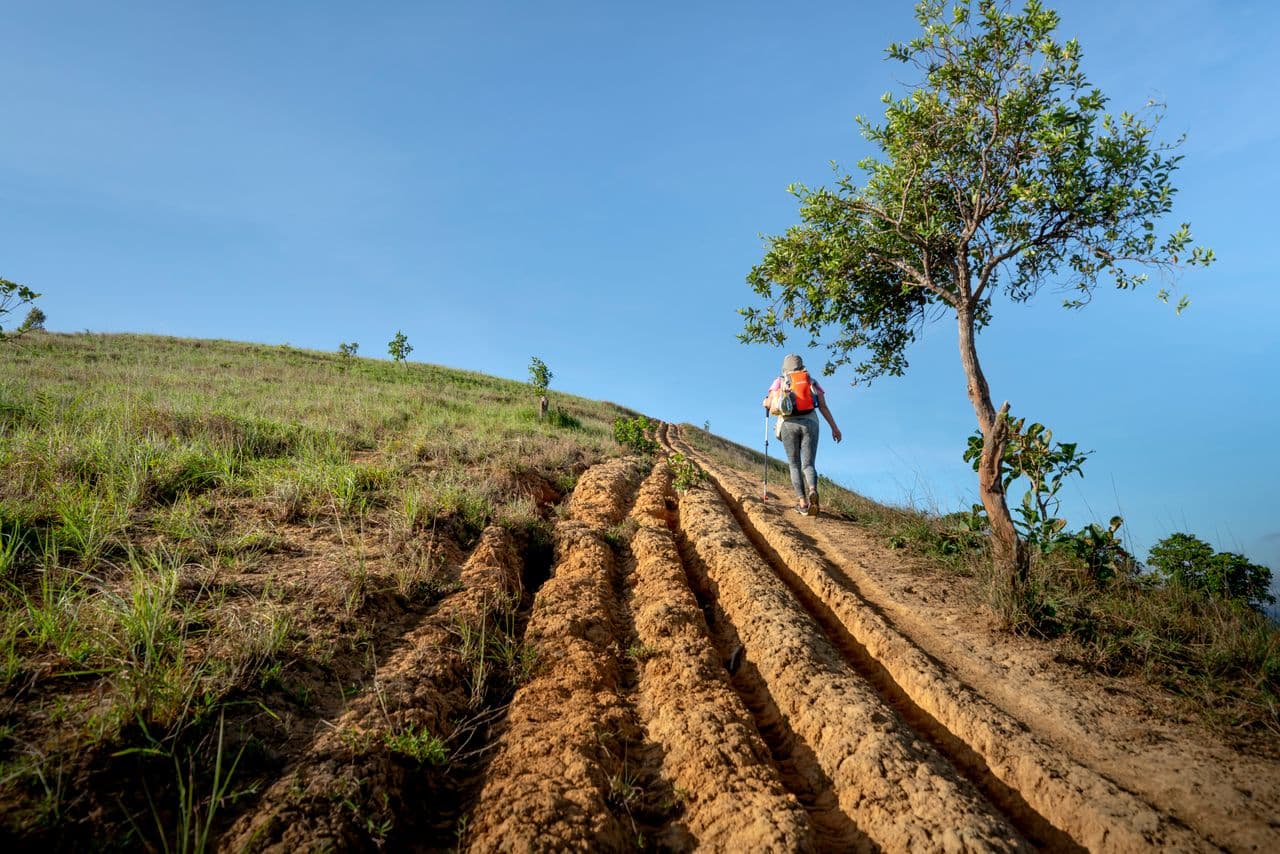
A flat, well-maintained path and a steep, technical scramble at the same distance and temperature are not the same hike physiologically. Elevation gain recruits more muscle mass, raises heart rate, and increases both sweat rate and breathing rate, all of which compound your water loss independent of how hot it is outside. A heavier pack adds to this same effect, since your body is doing measurably more mechanical work to move the same distance. This calculator's intensity setting captures that with a modest downward adjustment for genuinely easy, flat terrain and a meaningful upward adjustment for steep or heavily loaded hikes, on top of whatever the temperature band already applies.
Carrying It: Bottles, Bladders, and Filtering
Beyond a few miles, carrying every liter as dead weight in bottles gets impractical fast, water weighs almost exactly 1 kg per liter, so 4 liters is 4 extra kilograms on your back before you've packed anything else. Hydration bladders (the tube-and-reservoir style worn inside a pack) make sipping small amounts continuously easier than stopping to unscrew a bottle, which in practice means people actually drink closer to their real needs instead of underdrinking to avoid the hassle. On longer or multi-day routes, a lightweight water filter or purification tablets let you refill from streams and lakes along the way rather than carrying a full trip's worth of water from the trailhead, which is usually the more practical answer once a hike stretches past what 2 to 3 liters of carried capacity can cover.
A Worked Example
A 5-hour hike, hot conditions, moderate intensity: the base rate of 0.5 L/hour gets multiplied by the hot-weather factor of 1.6 and the moderate-intensity factor of 1.0, landing at 0.8 L/hour. Over 5 hours, that's 4 liters total, or roughly 135 fluid ounces, the equivalent of eight 500ml bottles or four 1-liter bottles. Switch the same hike to strenuous intensity (a steep, technical route or a heavy overnight pack) and the rate climbs to exactly 1 L/hour, pushing the same 5-hour hike to a full 5 liters, a genuinely different packing decision than the 4-liter moderate-intensity version of the same trip.
Signs You're Behind on Water
Thirst itself is a lagging indicator, by the time you feel genuinely thirsty you're typically already running a mild deficit. Dark yellow urine, a headache that builds through the hike rather than one that was already there at the trailhead, and unusual fatigue on a grade you'd normally handle fine are all earlier, more useful signals than thirst alone. On a hot day, pairing water intake with electrolytes (sodium in particular) matters too, since sweating out water without replacing sodium can itself cause problems on long, hot efforts, a separate issue from simple dehydration that plain water alone doesn't fully solve.
How to Use This Calculator
Enter your expected hike duration in hours, pick the temperature band that best matches the day, and choose a trail intensity that reflects the terrain and your pack weight. The result shows your estimated hourly rate, total liters and ounces to carry, and how that translates into standard 500ml and 1-liter bottle counts.
Frequently Asked Questions
Is half a liter per hour enough for every hike?+
Only as a baseline for moderate temperatures and moderate effort. Heat, elevation gain, and pack weight all push real needs well past that figure, sometimes to double it or more on a genuinely hot, strenuous day.
Should I drink even if I'm not thirsty yet?+
Generally yes, on a planned schedule rather than waiting for thirst, since thirst tends to show up after a mild deficit has already started building.
Does carrying more water than I need cause any problems?+
Mostly just extra pack weight, since water weighs about 1 kg per liter. Overhydration without electrolytes on extremely long, hot efforts is a separate, rarer concern, but for a typical day hike the bigger real-world risk is carrying too little, not too much.
What if I'm planning to filter water on the trail instead of carrying it all?+
This calculator estimates your total consumption, not what you need to physically carry. If you're filtering from streams along the way, you can carry less and refill, as long as reliable water sources are actually confirmed on your specific route.
Do I need to pack extra water for my dog too?+
Yes, a hiking dog needs its own supply on top of yours, heat and exertion raise its water needs the same way they raise a human hiker's. The Dog Water Intake Calculator covers the daily target by weight, diet, and activity level.
Plan for the weather, not just the miles.
Duration matters, but heat and terrain move the number more than distance alone ever will. If you're also dialing in supplement timing around training days, the Creatine Dosage Calculator covers a related piece of the hydration picture, since creatine users specifically need to stay on top of fluid intake.
When in doubt, pack for the hotter estimate, not the cooler one.
Sources and References
- REI Co-op. Hydration Basics: How to Stay Hydrated. rei.com. Accessed August 2026.
- American Hiking Society. Hiking hydration guidelines. americanhiking.org. Accessed August 2026.